Cyclone is an indispensable separation and classification equipment in industrial production. Whether it is in mineral processing, chemical industry, or desulfurization, it relies on it to accurately separate coarse and fine particles, as well as light and heavy phase substances in mixed materials. The key to whether the cyclone can withstand the test of working conditions and work stably for a long time lies in the inner lining – just like putting a layer of “protective armor” on the equipment. Choosing the right material for the inner lining can reduce equipment failures and prolong its service life. Among numerous lining materials,silicon carbide industrial ceramicshave become the preferred choice under harsh working conditions due to their outstanding performance.
Some people may wonder why it is necessary to use good materials for the lining of the cyclone? In fact, when the cyclone is working, the material rotates at high speed under pressure, and there will be strong erosion and friction between the particles and the inner lining. If it encounters corrosive media, the inner lining also has to withstand corrosion invasion. Ordinary materials will wear and leak soon, which not only requires frequent shutdowns and replacement of parts to delay production, but also increases operation and maintenance costs. In the past, rubber and ordinary metal were commonly used as lining materials, which had certain effects. However, when faced with high-speed sharp particle erosion and high-temperature corrosive environments, the shortcomings were very obvious. Either they were not wear-resistant and easy to break, or they were not corrosion-resistant and prone to aging, making it impossible to meet various demanding requirements.
The lining of the silicon carbide cyclone can precisely fill these gaps, relying on its solid material advantages. The most outstanding performance is wear resistance. Silicon carbide has a particularly high hardness, second only to diamond. Faced with high-speed particle erosion, it will not be slowly worn down like ordinary materials, but can steadily withstand friction. Even if sharp particles with sharp edges continue to impact, the inner lining surface can remain smooth and intact, fundamentally reducing the losses caused by wear. Moreover, its wear resistance is not delicate, and it can maintain stable wear resistance regardless of material concentration or flow rate, without the need to frequently worry about lining wear and failure.
In addition to wear resistance, corrosion resistance is also a major highlight of silicon carbide lining. In many working conditions of industrial production, acidic and alkaline media are encountered. These corrosive media are the “natural enemies” of metal lining, which can easily cause corrosion perforation and accelerate the aging of rubber lining. Silicon carbide has particularly stable chemical properties, and except for a few special media, it hardly reacts with acid and alkali salts, like building a “chemical protection wall”. Even if corrosive media wash away, the lining can be safe and sound, avoiding losses caused by material leakage and reducing environmental risks.
The high temperature resistance makes the lining of the silicon carbide cyclone suitable for more complex working conditions. Some industrial processes have high material temperatures, and ordinary lining will soften and deform at high temperatures, resulting in a decrease in wear resistance. However, silicon carbide can withstand high temperature environments and still maintain high strength, high hardness, and stable performance at high temperatures.
Another crucial point is that the surface smoothness of the silicon carbide lining is high, the friction coefficient is small, and the material is not easily attached to the wall when flowing in the cyclone. In this way, it can ensure that the separation and classification efficiency of the cyclone is not compromised, and reduce the blockage caused by material adhesion and accumulation, keeping the equipment in a highly efficient operating state and indirectly improving production quality and efficiency.
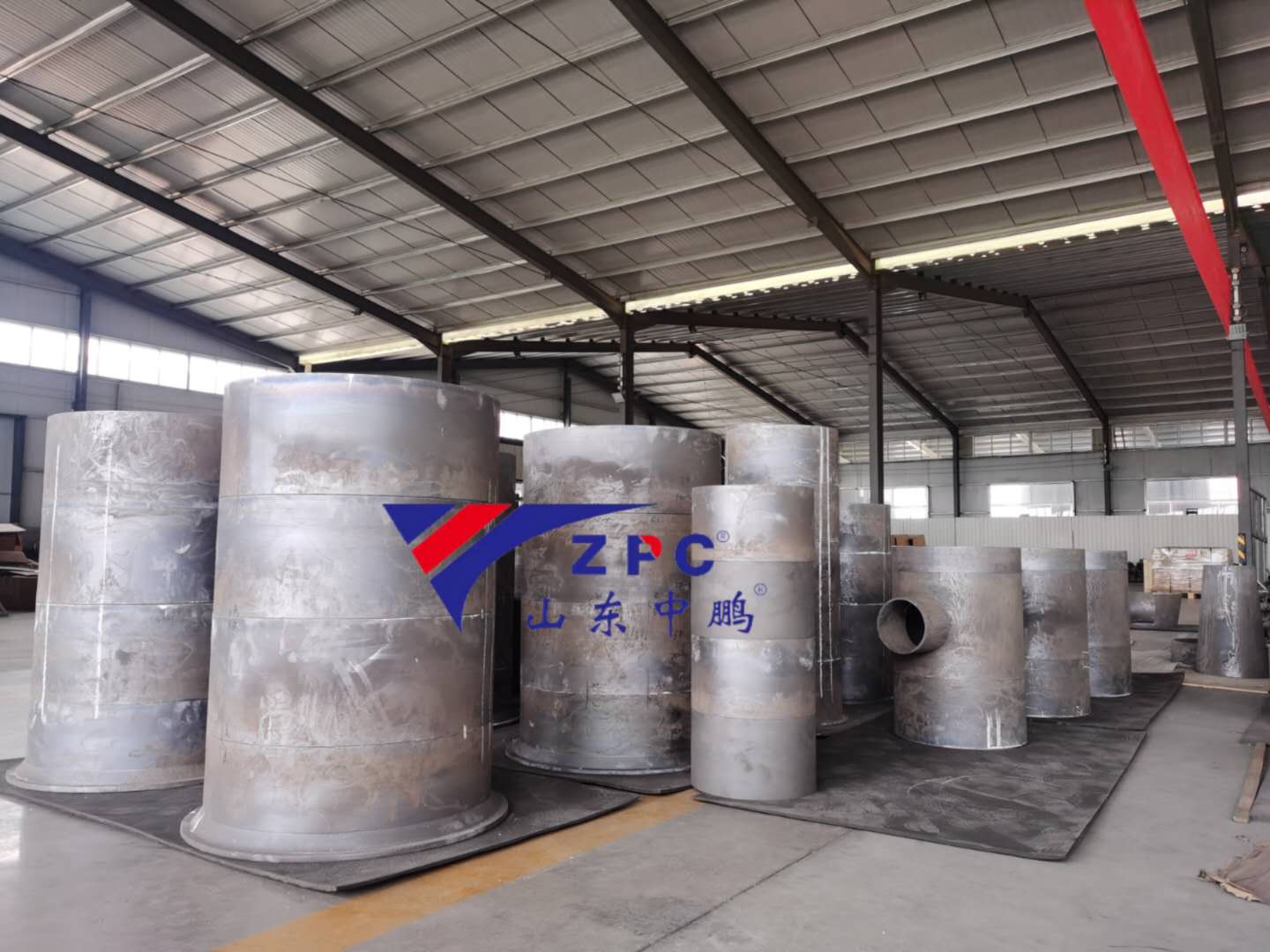
Some people may wonder if such a hardcore lining is too delicate? In fact, as long as the early control is done well in the working conditions to avoid direct impact of oversized particles and hard objects, the performance of the silicon carbide lining can be stably exerted. Although it does not have the same strength and toughness as rubber, it excels in hardness and stability, using a “hard hitting” approach to deal with wear and corrosion, which perfectly meets the core working requirements of cyclones.
Nowadays, industrial production is increasingly pursuing high efficiency, low consumption, and stability. The lining of silicon carbide cyclones has gradually become the choice of more enterprises due to its multiple advantages of wear resistance, corrosion resistance, and high temperature resistance. It can not only extend the service life of the cyclone and reduce the frequency of shutdown maintenance, but also safeguard the continuity of production. With hard core materials, it empowers equipment to operate efficiently and becomes a true “protective guard” in industrial production.
In the future, with the continuous improvement of silicon carbide industrial ceramic technology, the lining of silicon carbide cyclones will also be adapted to more complex working conditions, contributing to the improvement of industrial production quality, cost reduction, and green development.
Post time: Dec-30-2025