In the core process of industrial flue gas treatment, the desulfurization nozzle is a crucial component that silently exerts its power – it acts like a spray head performing “deep cleaning” on the flue gas, atomizing the desulfurization slurry into tiny droplets that fully react with pollutants such as sulfur dioxide, thereby safeguarding air quality. Among various nozzle materials,silicon carbide, with its unique advantages, has become the preferred choice in industrial settings, serving as a veritable “hardcore guardian” in desulfurization systems.
Many people may be curious as to why silicon carbide is specifically chosen. This can be traced back to the harsh environment of desulfurization work. Industrial flue gas not only contains a large amount of highly corrosive chemicals, but also high-speed flowing dust particles. At the same time, the working environment experiences significant temperature fluctuations, making it difficult for ordinary materials to withstand. Metal nozzles are prone to corrosion and rusting, while ordinary ceramics cannot withstand particle erosion and will soon experience wear and cracking, affecting the desulfurization effect.
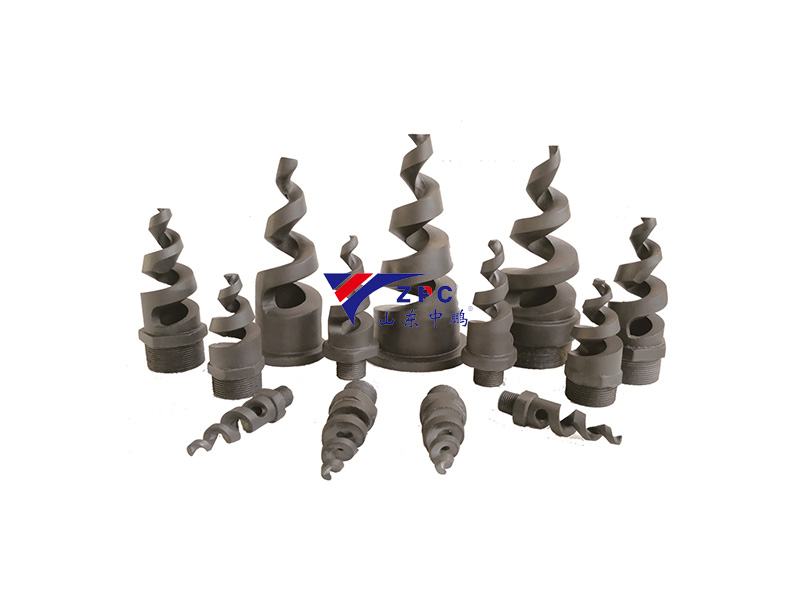
The remarkable aspect of silicon carbide lies in its ability to easily tackle these challenges. As a ceramic material with outstanding performance, its hardness is second only to diamond. When faced with the scouring of high-speed dust, it acts like wearing a layer of “armor”, with a wear resistance far exceeding that of metals and ordinary ceramics. Its chemical properties are extremely stable, maintaining structural integrity in both strong acid and strong alkali environments without corrosion or damage. With low resistance, it can form uniform and fine droplets, maximizing the contact area between pollutants and slurry, thereby enhancing desulfurization efficiency. Moreover, its smooth surface is less prone to scaling and clogging, making subsequent maintenance more convenient. There is no need for frequent downtime for replacement, significantly reducing maintenance costs and downtime losses in industrial production.
Nowadays, in industries requiring flue gas desulfurization, such as thermal power generation, steel metallurgy, and chemical engineering, silicon carbide desulfurization nozzles have become the mainstream choice. With its advantages of wear resistance, corrosion resistance, and high temperature resistance, it can operate stably for a long time under harsh working conditions, ensuring the efficient operation of the desulfurization system, reducing the overall cost for enterprises, and promoting the coordinated development of industrial production and environmental protection.
Post time: Jan-03-2026