In the production processes of heavy industries such as mining, power, metallurgy, and chemical engineering, various conveying pipelines and separation equipment are constantly subjected to multiple forms of wear, including erosion by high-speed solid-liquid media, corrosion from acidic and alkaline substances, and alternating thermal cycling. Traditional metal housings, rubber linings, and conventional wear-resistant coatings are prone to issues like thinning inner walls, perforation, material leakage, and delamination under prolonged abrasion. Frequent shutdowns for maintenance and spare part replacement not only disrupt production continuity but also continuously escalate overall operational costs. Silicon carbide wear-resistant linings, leveraging the inherent properties of specialty ceramic materials, provide integrated long-term protection for equipment inner walls, emerging as the mainstream upgrade solution for addressing high-wear operational challenges.
From the perspective of material science, silicon carbide is a dense ceramic material formed through strong covalent bonding. After high-temperature sintering, its overall structure is uniform and stable, eliminating the shortcoming of easily peeling surface protective layers. Unlike conventional wear-resistant solutions that rely on coatings or adhesive layers for protection, silicon carbide wear-resistant linings possess consistent wear and corrosion resistance throughout their entire body. Even under prolonged exposure to particle cutting impacts, they do not exhibit localized performance degradation, fundamentally adapting to high-intensity industrial wear environments.
The wear on the inner walls of industrial equipment is typically the result of both mechanical erosion and chemical corrosion. The core advantage of silicon carbide wear-resistant linings lies precisely in their ability to address both types of wear challenges simultaneously.
First, outstanding resistance to abrasion and erosion. When subjected to high-speed friction and impact from high-hardness materials such as slurry, fly ash, and sand, the dense crystalline structure of silicon carbide can withstand particle cutting wear, preventing the formation of grooves and damage over prolonged use. This significantly extends the stable operation cycle of equipment and reduces the frequency of spare part replacements. Particularly in critical areas with the most concentrated erosion, such as elbows, cones, and slurry inlets, the internal lining provides even more outstanding protection.
Secondly, stable and reliable chemical corrosion resistance. Silicon carbide exhibits extremely strong chemical inertness, remaining unaffected by dissolution, aging, or expansion in acidic slurry, alkaline waste liquid, or saline environments. Even with prolonged exposure to corrosive materials, its material structure and performance remain stable, achieving dual protection of wear resistance and corrosion resistance.
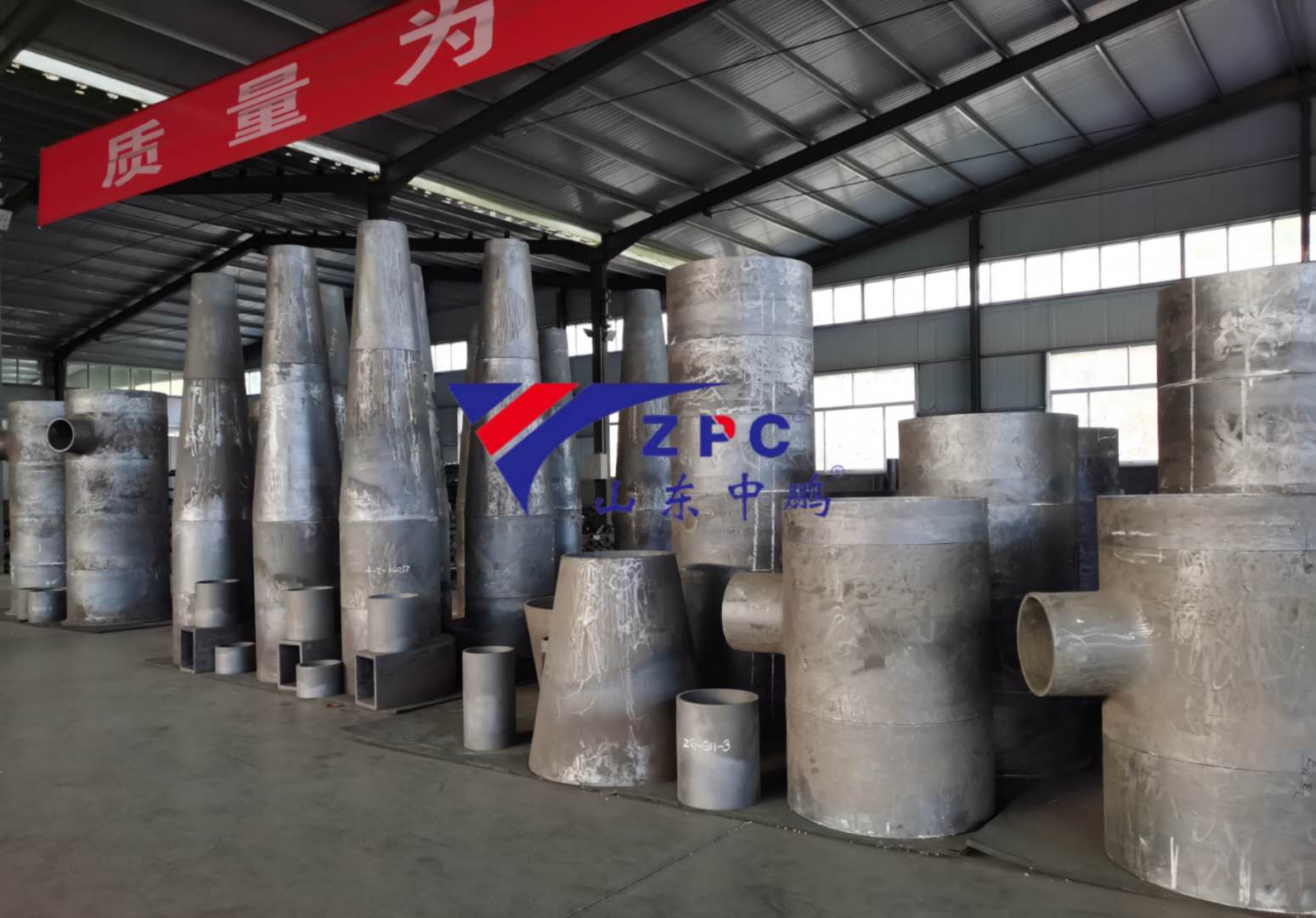
Meanwhile, the smooth and glossy inner wall of the silicon carbide lining reduces material flow resistance, effectively minimizing issues such as medium adhesion, scaling, and clogging. This ensures long-term stable transportation and separation accuracy for pipelines and equipment, while being resistant to cracking and deformation, making it suitable for various high-temperature fluctuating production scenarios.
In terms of structural adaptation design, the silicon carbide wear-resistant lining can seamlessly integrate with the steel outer shell, forming an integrated device with complementary internal and external layers: the outer metal shell bears the functions of pressure resistance, support, and on-site installation adaptation, while the inner silicon carbide lining directly isolates abrasive and corrosive media, meeting both the mechanical strength requirements of the equipment and the long-term protection needs of the inner wall. The lining supports customized molding, compatible with various shaped equipment such as straight pipes, elbows, tees, cyclone cones, and chutes. It can adjust the lining structure and thickness based on the wear intensity of on-site working conditions, adapting to diverse process scenarios including classification, slag transport, desulfurization, and chemical medium conveyance.
For industrial production enterprises, upgrading to silicon carbide wear-resistant linings is a pragmatic choice that balances cost-effectiveness and operational stability. The long-lasting protective properties directly reduce unplanned downtime, lower spare parts procurement and manual maintenance investments, enabling the entire production line to maintain continuous and stable operation. Over the long term, this effectively compresses overall operating costs while achieving multiple benefits such as quality improvement, efficiency enhancement, and loss reduction.
With years of dedicated research and production in wear-resistant products made from silicon carbide specialty ceramics, we specialize in the precision processing and quality control of high-grade silicon carbide wear-resistant linings. Leveraging mature raw material formulation, high-temperature sintering, and precision machining technologies, our linings achieve uniform density, high dimensional accuracy, and stable comprehensive protective performance. Additionally, we provide customers with full-process technical services, including working condition diagnostics, customized solutions, and product selection guidance.
With the continuous improvement of standards for equipment longevity and low-maintenance in industrial production, traditional wear-resistant materials can no longer meet the increasingly demanding production conditions. Silicon carbide wear-resistant linings, with their unparalleled comprehensive protective advantages, are gradually replacing traditional lining products and becoming the preferred choice for wear-resistant upgrades in mining and industrial equipment. In the future, we will continue to optimize the formulation of silicon carbide materials and the molding process of linings, consistently delivering stable and durable wear-resistant lining products to support the long-term safe operation of equipment across various industries and empower green, efficient industrial production.
Post time: Jun-25-2026