In the environmental protection aspect of industrial production, flue gas desulfurization is a crucial step in safeguarding the atmospheric environment. The core component of the desulfurization system, the silicon carbide desulfurization nozzle, is like an “atomization expert” for flue gas purification, silently shouldering the heavy responsibility of efficient desulfurization. Many people are not familiar with this small component. Today, let’s use simple language to talk about what makes the silicon carbide desulfurization nozzle so special.
The core mission of the desulfurization nozzle is to transform the desulfurization slurry into fine droplets, allowing these droplets to fully contact the flue gas containing sulfides, thereby “capturing” and reactively removing the harmful sulfides from the flue gas. Despite its seemingly simple task, this job requires facing an extremely harsh working environment: the desulfurization slurry is corrosive, and the high-speed flowing slurry continuously scours the nozzle. The high-temperature flue gas also constantly tests the heat resistance of the components, making nozzles made of ordinary materials simply inadequate for the job.
Silicon carbide material is the key to solving this problem. Silicon carbide is a ceramic material with excellent performance and extremely high hardness, second only to diamond. Faced with the continuous erosion of particles in the desulfurization slurry, it can maintain the smoothness of the flow channel for a long time without being easily worn or deformed. At the same time, it also has strong corrosion resistance. No matter it is acidic or alkaline desulfurization slurry, it cannot be easily eroded by its structure. In high-temperature flue gas environment, it can maintain stable performance without cracking or deformation. Compared with traditional metal nozzles, silicon carbide desulfurization nozzles can work stably for a long time under harsh working conditions, fundamentally reducing the trouble of downtime and replacement due to nozzle damage.
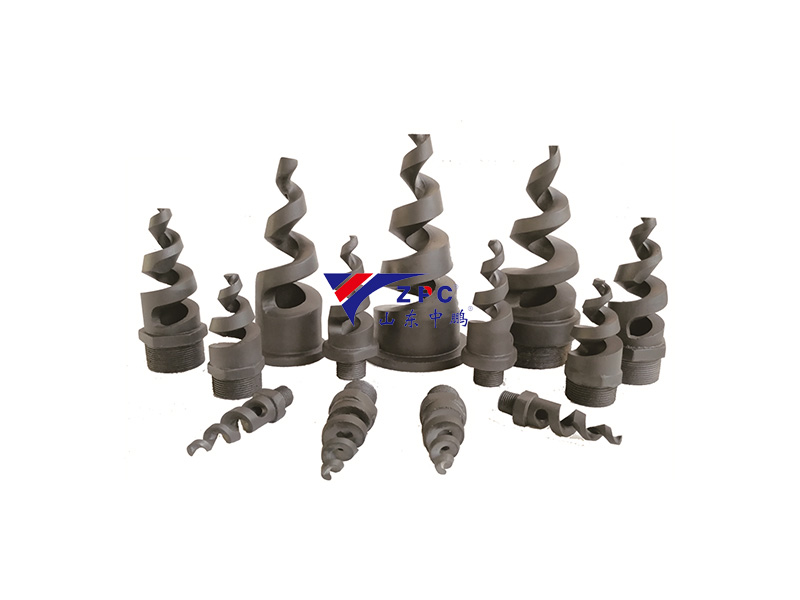
In addition to its material advantages, the design of silicon carbide desulfurization nozzles also meets the actual needs of desulfurization. Most mainstream silicon carbide desulfurization nozzles adopt a straight-through flow channel design without an inner core. This design allows the slurry to flow more smoothly, greatly reducing the probability of blockage and avoiding the impact of nozzle blockage on desulfurization efficiency. At the same time, the precisely designed flow channel can atomize the desulfurization slurry into micron-sized fine droplets, significantly increasing the contact area between the droplets and the flue gas. This enables a more thorough absorption reaction of sulfides, naturally resulting in better desulfurization effects.
As an indispensable key component in wet desulfurization systems, the silicon carbide desulfurization nozzle, despite its small size, directly determines the operational efficiency and stability of the desulfurization system. With its characteristics of wear resistance, corrosion resistance, good atomization effect, and resistance to blockage, it has become the preferred component for flue gas desulfurization in industries such as electricity, steel, and chemical engineering, laying a solid foundation for industrial enterprises to achieve green production and meet emission standards.
Nowadays, with the continuous improvement of environmental protection requirements, the performance requirements for equipment in industrial flue gas treatment are also upgrading. Silicon carbide desulfurization nozzles are also undergoing continuous optimization of design and process, providing more reliable support for the industrial environmental protection cause and becoming an important bridge between industrial production and ecological protection.
Post time: Jan-22-2026