In the flue gas treatment processes of industries such as thermal power, metallurgy, cement, and chemical engineering, wet flue gas desulfurization towers serve as the core equipment for achieving waste gas purification and compliant emissions. As the terminal core component of the spray system, the desulfurization nozzle directly determines the slurry atomization effect and desulfurization reaction efficiency. The internal working conditions within the desulfurization tower are extremely harsh, with lime slurry continuously high-speed eroding the nozzle’s interior while flue gas and slurry reactions generate acidic corrosive media. Under this dual degradation, ordinary metal, plastic, and standard ceramic nozzles are prone to issues such as nozzle hole wear and enlargement, corrosion-induced perforation, flow channel blockage, and atomization failure. Frequent nozzle replacement not only disrupts the continuous operation of the entire desulfurization system but also continuously increases the comprehensive costs of spare parts procurement and manual maintenance. Silicon carbide desulfurization nozzles, leveraging the inherent advantages of specialty ceramic materials, fundamentally resolve the multiple degradation challenges in desulfurization processes, making them the mainstream choice for upgrading flue gas purification equipment.
From the perspective of material science, silicon carbide forms a dense and uniform crystalline structure through strong covalent bonds, achieving one-piece sintering via high-temperature reactions. The overall material properties are uniform, eliminating the risk of delamination seen in coated or plated products. Compared to conventional wear-resistant and corrosion-resistant materials, silicon carbide combines high hardness, strong chemical inertness, and excellent thermal shock resistance, making it perfectly suited for the complex environment of desulfurization towers where wear, corrosion, and thermal cycling coexist. This also serves as the fundamental basis for its long-term stable service.
The wear of desulfurization nozzles is primarily categorized into mechanical abrasion and chemical corrosion. Silicon carbide material can effectively counteract both wear sources. On one hand, its ultra-hard dense crystalline structure resists continuous cutting and impact from hard particles in the slurry, ensuring no significant deformation of the inner cavity and spray holes over prolonged use. This maintains stable spray patterns and coverage, guaranteeing full gas-liquid contact and consistent desulfurization performance. On the other hand, silicon carbide’s stable chemical properties prevent dissolution or oxidation when exposed to acidic media or high-salt slurries during the desulfurization process. Unlike metal nozzles prone to pitting or plastic nozzles susceptible to aging and cracking, it integrates both wear resistance and corrosion resistance.
.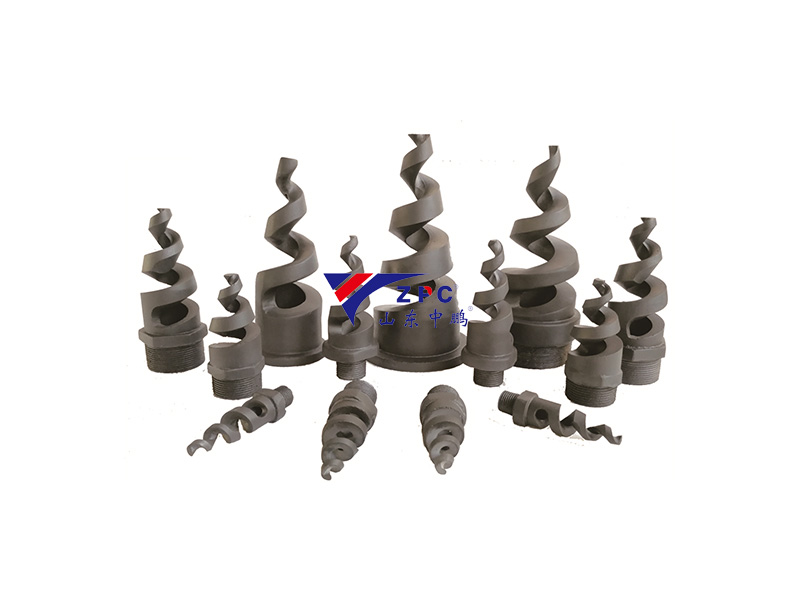
In practical use, the silicon carbide desulfurization nozzle is compatible with various connection structures such as standardized threads and flanges, and can directly replace various traditional nozzles. The modification threshold is low and does not require significant changes to the spray pipeline. The product specifications cover various flow rates and injection angles, including large, medium, and small, and can match desulfurization equipment with different tower diameters and processing air volumes. Whether it is a large power plant spray layer or a small and medium-sized boiler exhaust gas scrubbing tower, customized adaptation solutions can be provided. Under long-term use, the frequency of nozzle replacement is significantly reduced, reducing the production capacity stagnation and environmental emission fluctuations caused by the shutdown and maintenance of desulfurization towers, and helping enterprises achieve the dual goals of stable compliance, cost reduction, and efficiency improvement.
We have been deeply involved in the research and production of wear-resistant and environmentally friendly accessories for silicon carbide special ceramics for many years, focusing on formula optimization, precision molding, and high-temperature sintering process polishing of silicon carbide desulfurization nozzles. Strictly control the entire process of raw material screening, inner cavity precision processing, and finished product testing to ensure the smoothness, dimensional accuracy, and overall density stability and reliability of each nozzle inner cavity. At the same time, provide supporting technical services such as selection and installation guidance based on customer on-site conditions, and adapt to various flue gas desulfurization and exhaust gas washing and spraying scenarios.
Post time: Jul-20-2026